PI-SPI: what the BCEAO's instant payment system changes for the WAEMU
Launched on 30 September 2025, the BCEAO's interoperable instant payment platform connects banks, microfinance and e-money across the Union's eight countries. Here's what it means.
For years, moving money from a bank account to a mobile wallet, or from one e-money provider to another, was an obstacle course in the WAEMU: delays, stacked fees, and sometimes no bridge at all. With PI-SPI, the Central Bank of West African States (BCEAO) aims to turn those silos into a single network.
What is PI-SPI?
PI-SPI, the Interoperable Platform of the Instant Payment System (Plateforme Interopérable du Système de Paiement Instantané), is the BCEAO's public instant payment infrastructure. It lets a customer of one participating institution pay or transfer money to a customer of another, whatever the type of institution, in seconds.
Three things define it:
- Instant: funds reach the recipient in real time.
- Always on: the platform runs 24 hours a day, 7 days a week, including weekends and public holidays.
- Interoperable: banks, decentralised financial systems (microfinance), e-money issuers and payment institutions all connect to the same system.
It covers the eight WAMU countries: Benin, Burkina Faso, Côte d'Ivoire, Guinea-Bissau, Mali, Niger, Senegal and Togo.
A multi-year project
The platform didn't appear overnight:
| Milestone | Date |
|---|---|
| Testing phase begins | 22 July 2024 |
| Live pilot phase | 5 June 2025 |
| Official launch in Dakar | 30 September 2025 |
The official launch was led by BCEAO Governor Jean-Claude Kassi Brou, with a symbolic first transaction. The project received financial support from the Gates Foundation, with the funds administered by the African Development Bank.
According to figures from the BCEAO's 2025 annual report, as reported in the press, 74 institutions were already connected to the platform by 31 December 2025.
Why it matters
For individuals
Much of everyday spending already runs on e-money, while salaries and savings often stay in banks. A shared, instant system removes friction between the two: you can pay someone without asking where they hold their account.
For merchants
An instant payment is a certain, immediate collection. For a merchant, that means less waiting before the day's takings are available, and the ability to accept customers from any participating institution.
For financial inclusion
The BCEAO presents PI-SPI as a lever for financial inclusion: by making transfers simpler, faster and reachable from any institution, it encourages people to use formal financial services rather than cash.
What we're watching at Kori
At Kori, our mission is to make payments simple for everyone. A public, instant and interoperable infrastructure points in the same direction.
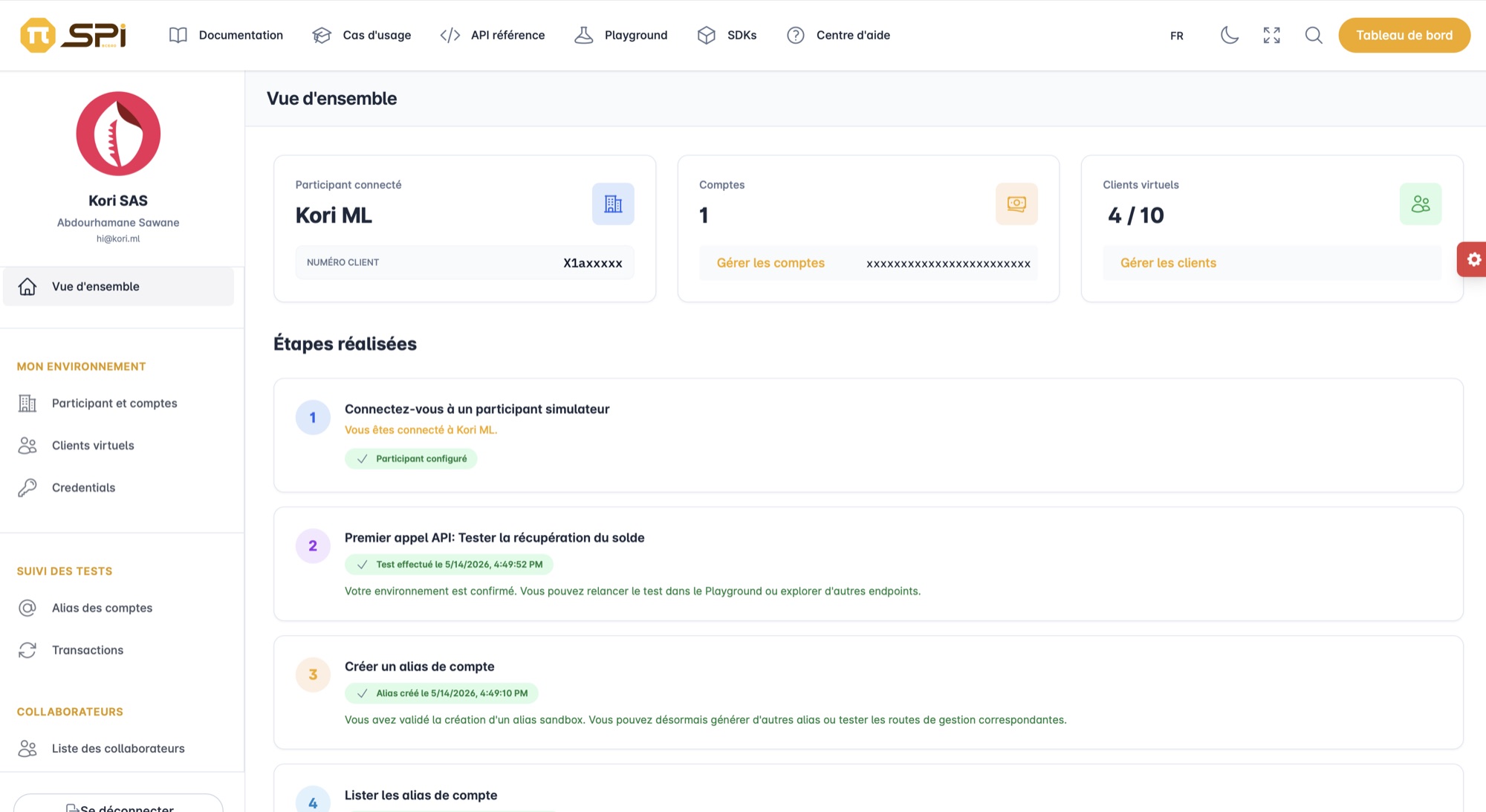
We're not just watching from the sidelines: Kori is connected to the PI-SPI test environment as a simulator participant. Our first API calls, such as balance lookup and account alias creation, have already been validated there.
We'll follow how PI-SPI evolves and what it makes possible, and share our analysis here.
Interoperability isn't a feature: it's what it takes for digital payments to feel as natural as cash.
Sources: BCEAO announcements on the official launch of PI-SPI (bceao.int), Financial Afrik, Dakaractu.